
Symphyotrichum subulatum
Common names
bushy starwort, sea aster
Biostatus
Exotic
Conservation status
Not applicable
Category
Vascular
Structural class
Herbs - Dicotyledonous composites
Simplified description
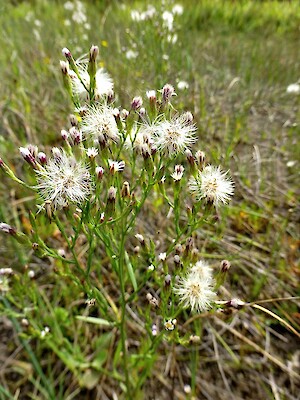
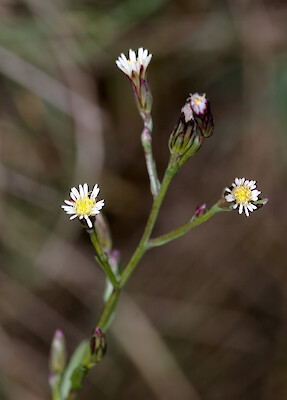
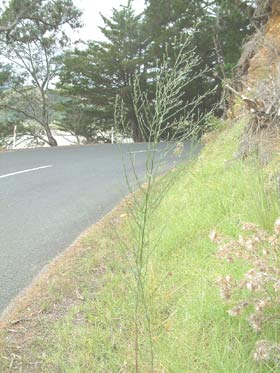
Tall, spindly, straight-stemmed almost hairless annual or short-lived perennial herb up to 2 m tall, with small pale purple flowers produced on a many-branched flower stalk
Flower colours
Violet/Purple, Yellow
Detailed description
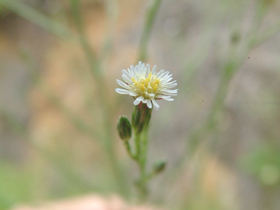
Tap-rooted annual or short-lived perennial herb, glabrous or rarely with a few hairs on upper stem; stems erect, terete, sparingly branched below, 20-200 -(300) cm tall, rarely stems resprouting and somewhat woody after flowering. Mid cauline lvs lanceolate to linear, apetiolate and cuneate, acute, crenulate or remotely serrulate, 35-150 × 3-10-(20) mm; lowermost lvs mostly petiolate, elliptic, cuneate, obtuse; uppermost lvs linear. Infl. a many-headed diffuse panicle. Capitula 2-5 mm diam. Involucral bracts very unequal; inner bracts narrow-oblong to subulate, acute to slightly acuminate, green toward apex and along midrib, purplish at apex and margins, 5-8 mm long; outer bracts not wholly herbaceous, c. 2 mm long. Ray florets numerous; ligules white to pale purple, c. 1-2 mm long. Achenes subcylindric to ellipsoid, compressed, 4-5-ribbed, 1.5-2.2 mm long, with sparse antrorse hairs.
Similar taxa
No similar species.
Distribution
Common in the North Island, also established in northern South Island.
Habitat
Wetland margins and coastal places, also in drier habitats including roadsides, wasteland and open grassland.
Detailed taxonomy
Genus
Family
Synonyms
Aster subulatus Michx.
Endemic family
No
Ecology
Flowering
Year-round
Fruiting
Summer to winter
Year naturalised
1896
Origin
North America, possibly also Central and South America
Reason for introduction
Unknown, seed or soil contaminant
Control techniques
Can be controlled manually, mechanically or herbicidally depending on situation.
Life cycle and dispersal
Wind dispersed seed.
Wetland plant indicator status rating
Information derived from the revised national wetland plant list prepared to assist councils in delineating and monitoring wetlands (Clarkson et al., 2021 Manaaki Whenua – Landcare Research Contract Report LC3975 for Hawke’s Bay Regional Council). The national plant list categorises plants by the extent to which they are found in wetlands and not ‘drylands’. The indicator status ratings are OBL (obligate wetland), FACW (facultative wetland), FAC (facultative), FACU (facultative upland), and UPL (obligate upland). If you have suggestions for the Wetland Indicator Status Rating, please contact: [Enable JavaScript to view protected content]
FAC: Facultative
Commonly occurs as either a hydrophyte or non-hydrophyte (non-wetlands).
Other information
Etymology
subulatum: Awl-shaped
NVS code
The National Vegetation Survey (NVS) Databank is a physical archive and electronic databank containing records of over 94,000 vegetation survey plots - including data from over 19,000 permanent plots. NVS maintains a standard set of species code abbreviations that correspond to standard scientific plant names from the Ngä Tipu o Aotearoa - New Zealand Plants database.
SYMSUB
Referencing and citations
References and further reading
Webb, C.J.; Sykes, W.R.; Garnock-Jones, P.J. (1988). Flora of New Zealand Volume 4: Naturalised pteridophytes, gymnosperms, dicotyledons. Botany Division, DSIR, Christchurch.
Popay et al (2010). An illustrated guide to common weeds of New Zealand, third edition. NZ Plant Protection Society Inc, 416pp.
Johnson PN, Brooke PA (1989). Wetland plants in New Zealand. DSIR Field Guide, DSIR Publishing, Wellington. 319pp.
Attribution
Factsheet prepared by Paul Champion and Deborah Hofstra (NIWA). Features description from Webb et al. (1988).
Some of this factsheet information is derived from Flora of New Zealand Online and is used under a Creative Commons Attribution 3.0 New Zealand licence.