
Gyroporus castaneus


Biostatus
Native
Category
Fungi
Structural class
Fungi
Detailed description
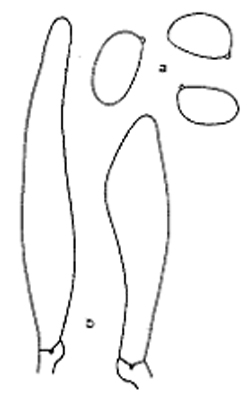
Pileus convex to plano-convex, 3.5–5.5 cm diam., dry, finely tomentose to velutinate, cocoa brown, chestnut brown, or cinnamon brown, usually with conspicuous clamp connections. Hymenophore tubes to 7 mm long, excavated around apex of stipe, white when young, pallid yellow at maturity; pores concolorous with tubes, subregular, 0.5–1 mm diam. Stipe 4–5 cm long, tapering apically, occasionally subcylindrical, 1–2 cm diam., solid at first, becoming stuffed, finally hollow, dry, tomentose to velutinate, concolorous with pileus or paler apically; flesh white to sordid white; annulus absent. Spores pallid stramineous, short-elliptical, often ovate and flattened on one side, 7.4–11.7 (–13) x 5.2–6.5 (–7.2) µm., smooth; spore print reported to be between amber yellow and citron yellow. Basidia hyaline, clavate, 27–35 x 9–12 µm, 4-spored; clamp connections present. Context of pileus white to sordid white, unchanging on exposure to air. Taste mild. Smell not distinctive.
Distribution
Auckland, ?Australia; widely distributed throughout temperate regions of the northern hemisphere.
Substrate details
Solitary, gregarious, or caespitose under Kunzea ericoides and Leptospermumscoparium.
Detailed taxonomy
Genus
Synonyms
Boletus castaneus Bull.
Ecology
Fruiting
This fungus has been collected on four occasions in January 1966 and June 1971 and 1973.