
Libocedrus plumosa
Common names
kawaka, NZ cedar
Biostatus
Native – Endemic taxon
Current conservation status
The conservation status of all known New Zealand vascular plant taxa at the rank of species and below were reassessed in 2022-2023 using the New Zealand Threat Classification System (NZTCS) – more information about this can be found on the NZTCS website. This report includes replaces all previous NZTCS lists for vascular plants. Previous assessments can be found here.
- Conservation status of vascular plants in Aotearoa New Zealand, 2023. 2024. Peter J. de Lange, Jane Gosden, Shannel P. Courtney, Alexander J. Fergus, John W. Barkla, Sarah M. Beadel, Paul D. Champion, Rowan Hindmarsh-Walls, Troy Makan and Pascale Michel Department of Conservation. Source: NZTCS and licensed by DOC for reuse under the Creative Commons Attribution 4.0 International licence.
2023 | Not Threatened | Qualifiers: Sp, DPS, DPT
Category
Vascular
Structural class
Trees & Shrubs - Gymnosperms
Flower colours
No flowers
Detailed description
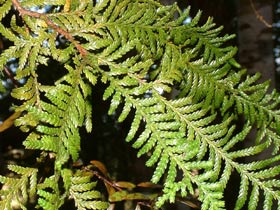
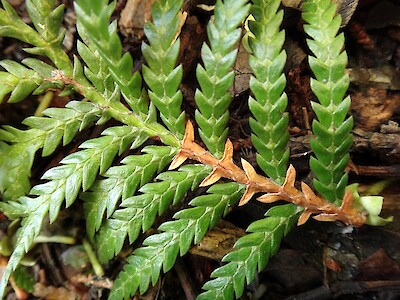
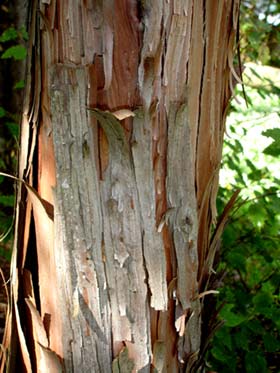
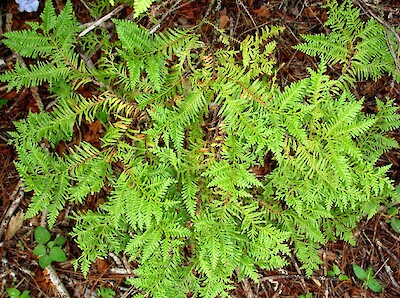
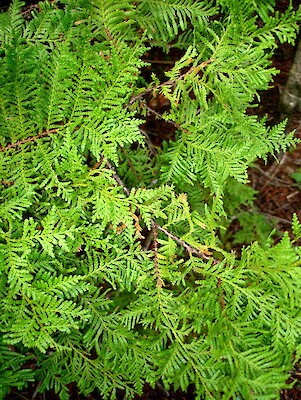
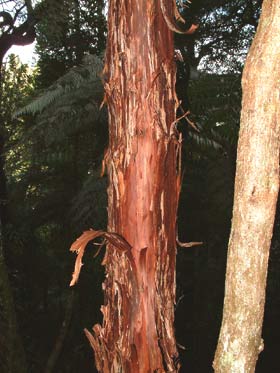
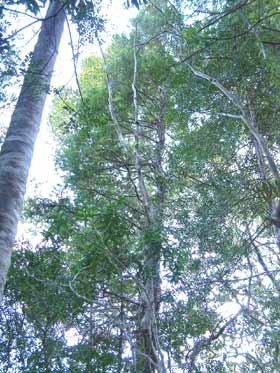
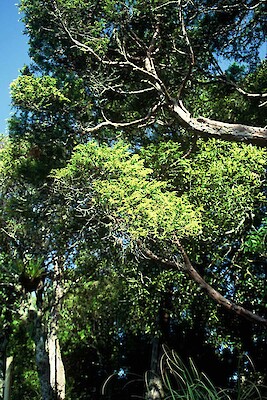
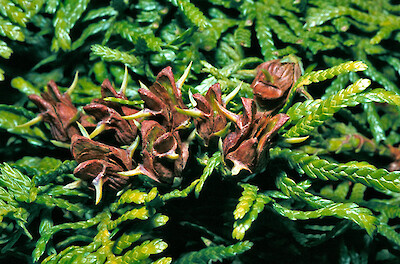
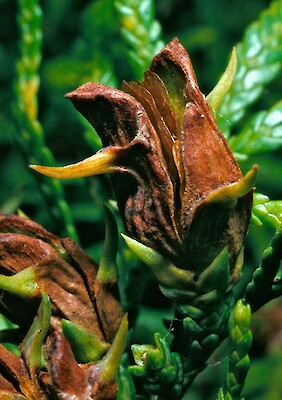
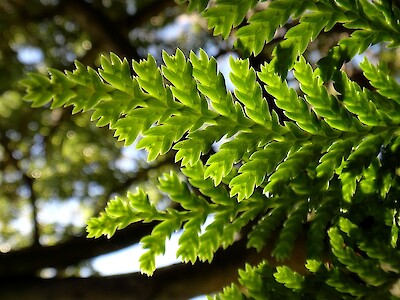
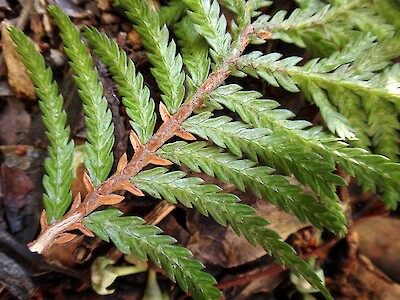
Evergreen, monoecious tree up to 35 m tall, 2–3 m d.b.h. Bark thin, scaly, light-brown to greyish-brown, peeling readily in long irregular, inrolled strips. Branches spreading or ascending, branchlets numerous, spreading, arrange din dense sprays in tiers above each other, forming a pyramidal crown in young trees, becoming conical, rounded or irregular in older specimens. Foliage in flattened sprays except when cone-bearing, ultimate branches subopposite to alternate, 15–35 × 2–6 mm, leafy, flattened, long persistent. Leaves decussate, on lateral branchlets shortly decurrent, imbricate, dimorphic, rhombic 1–2 × 1 mm, apiculate to acute, appressed, partially covered at base by 2–6 × 1.5–2 mm, divergent, bilaterally flattened, slightly curved laterals with entire margins and free apices; leave son older trees smaller and monomorphic. Male cones terminal, solitary, subglobose to ovoid, 3–5 mm, yellowish-green, maturing light brown. Female cones terminal subtended by weakly dimorphic leaves; comprising 2 decussate pairs of acute 4–6 mm long, spreading bracts subtended by 3–4 pairs of similar, gradually shorter leaves, the upper pair developing within one growing season to become thin, woody, and forming a cone 12–18 mm long. Seeds 2–4, ovoid, flattened, with an acute apex 3–5 mm long, brown, with a whitish hilum and 2 opposite, thin membranous wings of very unequal shape and size, the smaller a narrow strip less than 1 mm wide, the larger irregular oval-oblong, 6–8 × 3–4.5 mm, yellowish-brown.
Similar taxa
Libocedrus bidwillii is some what similar but within the range of L. plumosa it is confined to montane cloud forests (> 600 m.a.s.l.). It differs by the more or less quadrangular ultimate branchlets, nearly monomorphic leaves, and by the bracts subtending the cone bracts being less than or about ⅓ the size of the actual cone scales.
Distribution
Endemic. new Zealand: North Island (from Te Paki (Radar Bush) south to about the southern Kawhia Harbour in the west and near Gisborne in the East) and South Island (North-west Nelson, where it grows locally around the Golden Bay area from about Puponga south to the Anatori River).
Habitat
Coastal to lowland mixed broadleaf/hardwood forest. Often found in association with kauri (Agathis australis (D.Don.) Lindl.). Often on ridge lines, spurs, or forming apparently even-aged cohorts in sites of former major disturbance, such as in or around stabllised slips, slumps, or areas of major wind throw damage. This species tends to colonise more fertile soils and soils overlying high fertility (base-rich) substrates.
Threats
A widespread and at times locally common, though generally naturally sparse species. Although it was logged when suitable trees were found, its general scarcity meant that logging has had little effect on its overall distribution and abundance. This species may even have benefited from past logging because it is at its most abundant in places that were once heavily logged, and/or burned. In fact field evidence suggests that Libocedrus plumosa needs regular disturbance to maintain itself.
Detailed taxonomy
Genus
Family
Synonyms
Thuja doniana Hook., Libocedrus doniana (Hook.) Endl.
Endemic taxon
Yes
Endemic genus
No
Endemic family
No
Ecology
Flowering
July–September
Fruiting
July–June
Propagation technique
Easily grown from fresh seed which germinates within 4–8 months of sowing. An attractive conifer that makes and excellent specimen tree. It does best in a free draining, moderately fertile and moist soil, though once established it can tolerate considerable drought. It is moderately cold hardy but dislikes severe frosts. This species does not like much competition from other broad-leaf trees and to do best it should be planted as solitary specimens or as a monospecific plantings (in a stand).
Other information
Etymology
libocedrus: Frankincense cedar
plumosa: Feathery
NVS code
The National Vegetation Survey (NVS) Databank is a physical archive and electronic databank containing records of over 94,000 vegetation survey plots - including data from over 19,000 permanent plots. NVS maintains a standard set of species code abbreviations that correspond to standard scientific plant names from the Ngä Tipu o Aotearoa - New Zealand Plants database.
LIBPLU
Chromosome number
2n = 22
Previous conservation statuses
The conservation status of all known New Zealand vascular plant taxa at the rank of species and below were reassessed in 2022-2023 using the New Zealand Threat Classification System (NZTCS) – more information about this can be found on the NZTCS website. This report includes replaces all previous NZTCS lists for vascular plants. Previous assessments can be found here.
- Conservation status of vascular plants in Aotearoa New Zealand, 2023. 2024. Peter J. de Lange, Jane Gosden, Shannel P. Courtney, Alexander J. Fergus, John W. Barkla, Sarah M. Beadel, Paul D. Champion, Rowan Hindmarsh-Walls, Troy Makan and Pascale Michel Department of Conservation. Source: NZTCS and licensed by DOC for reuse under the Creative Commons Attribution 4.0 International licence.
2017 | Not Threatened | Qualifiers: Sp
2009 | At Risk – Naturally Uncommon
2004 | Sparse
Regional conservation statuses
Auckland: 2025 | Regionally At Risk – Regionally Declining | Qualifiers: DPS, DPT, DE, PF, RF
Current regional threat status assessments prepared according to Crisp et al. (2025) are displayed when available. The Auckland conservation status information is sourced from the “Conservation status of vascular plant species in Tāmaki Makaurau / Auckland” Simpkins E et al. (2025) report.
Northland: 2026 | Regionally At Risk – Regionally Naturally Uncommon
Current regional threat status assessments prepared according to Crisp et al. (2025) are displayed when available. The Northland conservation status information is sourced from the “Conservation status of indigenous vascular plants in Northland | Taitokerau” Ford et al. 2026 report.
Referencing and citations
References and further reading
Allan HH. 1961. Flora of New Zealand, Volume I. Indigenous Tracheophyta: Psilopsida, Lycopsida, Filicopsida, Gymnospermae, Dicotyledones. Government Printer, Wellington, NZ. 1085 p.
de Lange PJ, Rolfe JR, Barkla JW, Courtney SP, Champion PD, Perrie LR, Beadel SM, Ford KA, Breitwieser I, Schonberger I, Hindmarsh-Walls R, Heenan PB, Ladley K. 2018. Conservation status of New Zealand indigenous vascular plants, 2017. New Zealand Threat Classification Series 22. Department of Conservation, Wellington, NZ. 82 p. https://www.doc.govt.nz/globalassets/documents/science-and-technical/nztcs22entire.pdf
Farjon A. 2005. A monograph of Cupressaceae and Sciadopitys. Royal Botanic Gardens, Kew, UK. ISBN 1842460684. 643 p.
Webb CJ, Simpson MJA. 2001. Seeds of New Zealand Gymnosperms and Dicotyledons. Manuka Press, Christchurch. 428 p.
Attribution
Fact sheet prepared for NZPCN by P.J. de Lange 3 February 2006. Description adapted from Allan (1961), Webb & Simpson (2001) and Farjon (2005).
Some of this factsheet information is derived from Flora of New Zealand Online and is used under a Creative Commons Attribution 3.0 New Zealand licence.
NZPCN Fact Sheet citation
Please cite as: de Lange, P.J. (Year at time of access): Libocedrus plumosa Fact Sheet (content continuously updated). New Zealand Plant Conservation Network. https://www.nzpcn.org.nz/flora/species/libocedrus-plumosa/ (Date website was queried)