
Coprosma parviflora
Common names
leafy coprosma
Biostatus
Native – Endemic taxon
Current conservation status
The conservation status of all known New Zealand vascular plant taxa at the rank of species and below were reassessed in 2022-2023 using the New Zealand Threat Classification System (NZTCS) – more information about this can be found on the NZTCS website. This report includes replaces all previous NZTCS lists for vascular plants. Previous assessments can be found here.
- Conservation status of vascular plants in Aotearoa New Zealand, 2023. 2024. Peter J. de Lange, Jane Gosden, Shannel P. Courtney, Alexander J. Fergus, John W. Barkla, Sarah M. Beadel, Paul D. Champion, Rowan Hindmarsh-Walls, Troy Makan and Pascale Michel Department of Conservation. Source: NZTCS and licensed by DOC for reuse under the Creative Commons Attribution 4.0 International licence.
2023 | Not Threatened
Category
Vascular
Structural class
Trees & Shrubs - Dicotyledons
Simplified description
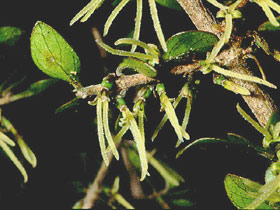
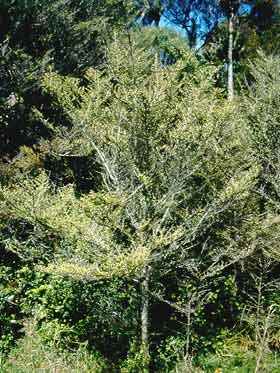
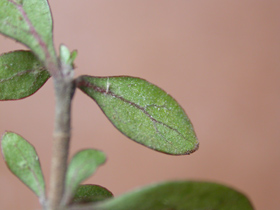
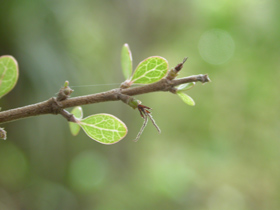
Bushy shrub in Northland with flattened wide angled branches bearing abundant clusters of pairs of small oval leaves. Twigs fuzzy towards tip. Leaves with tiny hairs underneath (best detected using tongue), 7-12mm long. Fruit white, pink or dark violet.
Flower colours
Green, White
Detailed description
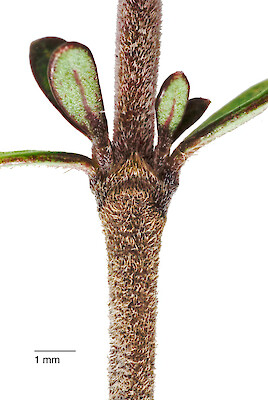
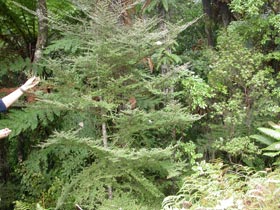
Shrub or small tree up to approximately 5 (-7) m tall. Branches, stout, bark pale grey to darker brown-grey; branchlets densely clad in appressed hairs when young. Leaves usually fascicled on slender pubescent petioles less than 1 mm long. Stipules triangular, hairy, ciliolate. Lamina coriaceous, glabrous, oblong to obovate, obtuse, cuneately narrowed to base, (4-5-) 7-12 (-18) × (2-) 4-6 mm, reticulations of veins usually evident below. Flowers terminal on short branchlets. Male flower solitary or 2-3 together; calyx not present; corolla funnelform, lobes approximately 3 mm long, more or less equal to tube, ovate, obtuse. Female flower solitary; calyx truncate, teeth minute; corolla-tube short, lobes approximately 2 mm long, linear, acute. Drupe dark purple or white and translucent, globose, shortly stalked, approximately 5 mm diameter. Seeds 2 obovate to elliptic to nearly circular, topside convex, underside slightly concave, surface finely grooved, dull pale orange-yellow to grey nut brown.
Similar taxa
Coprosma ciliata differs by having large generally orange drupes. The stipule of C. ciliata is tufted with long hairs and lacks a denticle. The juvenile leaves also have a distinctly hairy margin.
Coprosma rubra differs by having white or pale-yellow drupes and leaves which have a flattened petiole (leaf stalk).
Distribution
Endemic. Manawatāwhi | Three Kings Islands, and the Te Ika-a-Māui | North Island from Te Paki south to Auckland City (Remuera) but now extinct in the Auckland area. Still extant from the Kaipara Harbour north.
Habitat
Lowland to montane (0 – 600 m.a.s.l.), forest, shrubland, grassland, swampy and boggy places.
Detailed taxonomy
Genus
Family
Synonyms
Coprosma ciliata var. virgata Hook.f., Coprosma myrtillifolia Hook. f.
Taxonomic notes
There is herbarium material evidence that this species has naturally hybridised with Coprosma arborea (Glenny et. al., 2010).
Endemic taxon
Yes
Endemic genus
No
Endemic family
No
Ecology
Flowering
August - September (- October)
Fruiting
March - April (- October)
Life cycle and dispersal
Fleshy drupes are dispersed by frugivory (Thorsen et al., 2009).
Other information
Cultivation
Occasionally sold by retail plant and specialist native plant nurseries.
Etymology
coprosma: From the Greek kopros ‘dung’ and osme ‘smell’, referring to the foul smell of the species, literally ‘dung smell’
parviflora: From the Latin parvus ‘small, puny’ and flores ‘flowers’, meaning small-flowered.
Manaaki Whenua Online Interactive Key
NVS code
The National Vegetation Survey (NVS) Databank is a physical archive and electronic databank containing records of over 94,000 vegetation survey plots - including data from over 19,000 permanent plots. NVS maintains a standard set of species code abbreviations that correspond to standard scientific plant names from the Ngä Tipu o Aotearoa - New Zealand Plants database.
COPPAR
Chromosome number
2n = 132
Previous conservation statuses
The conservation status of all known New Zealand vascular plant taxa at the rank of species and below were reassessed in 2022-2023 using the New Zealand Threat Classification System (NZTCS) – more information about this can be found on the NZTCS website. This report includes replaces all previous NZTCS lists for vascular plants. Previous assessments can be found here.
- Conservation status of vascular plants in Aotearoa New Zealand, 2023. 2024. Peter J. de Lange, Jane Gosden, Shannel P. Courtney, Alexander J. Fergus, John W. Barkla, Sarah M. Beadel, Paul D. Champion, Rowan Hindmarsh-Walls, Troy Makan and Pascale Michel Department of Conservation. Source: NZTCS and licensed by DOC for reuse under the Creative Commons Attribution 4.0 International licence.
2017 | Not Threatened
2012 | Not Threatened
2009 | Not Threatened
2004 | Not Threatened
Regional conservation statuses
Auckland: 2025 | Regionally Threatened – Regionally Critical | Qualifiers: DPR, DPS, DPT, PF, RF
Current regional threat status assessments prepared according to Crisp et al. (2025) are displayed when available. The Auckland conservation status information is sourced from the “Conservation status of vascular plant species in Tāmaki Makaurau / Auckland” Simpkins E et al. (2025) report.
Northland: 2026 | Regionally At Risk – Regionally Declining | Qualifiers: DPS DPT
Current regional threat status assessments prepared according to Crisp et al. (2025) are displayed when available. The Northland conservation status information is sourced from the “Conservation status of indigenous vascular plants in Northland | Taitokerau” Ford et al. 2026 report.
Referencing and citations
References and further reading
Allan HH. 1961. Flora of New Zealand, Volume I. Indigenous Tracheophyta: Psilopsida, Lycopsida, Filicopsida, Gymnospermae, Dicotyledones. Government Printer, Wellington, NZ. Pg.571.
Glenny D, Cruickshank J, Morse C. and Rolfe J. 2010. Key to Coprosma species of New Zealand.
Accessed at https://www.landcareresearch.co.nz/tools-and-resources/identification/key-to-coprosma-species-of-new-zealand Date of access: 18/5/26.
Thorsen MJ, Dickinson KJM, Seddon PJ. 2009. Seed dispersal systems in the New Zealand flora. Perspectives in Plant Ecology, Evolution and Systematics 11: 285–309. https://doi.org/10.1016/j.ppees.2009.06.001.
Wilson HD & Galloway T. 1993. Small-leaved shrubs of New Zealand. Manuka Press. Pg 95.
Attribution
Fact sheet prepared for NZPCN by MD Ward (May 18th 2026). Description adapted from Allan (1961) and Wilson & Galloway (1993).
Some of this factsheet information is derived from Flora of New Zealand Online and is used under a Creative Commons Attribution 3.0 New Zealand licence.