
Pseudopanax crassifolius




Past favourite plant finalist
Common name
horoeka, lancewood
Synonyms
Aralia crassifolia Sol. ex A.Cunn., Panax crassifolium (Sol.) Decne et Planchon, Panax longissimum Hook.f., Panax coriaceum Regel, Hedera crassifolia Gray
Family
Araliaceae
Flora category
Vascular – Native
Endemic taxon
Yes
Endemic genus
No
Endemic family
No
Structural class
Trees & Shrubs - Dicotyledons
NVS code
The National Vegetation Survey (NVS) Databank is a physical archive and electronic databank containing records of over 94,000 vegetation survey plots - including data from over 19,000 permanent plots. NVS maintains a standard set of species code abbreviations that correspond to standard scientific plant names from the Ngä Tipu o Aotearoa - New Zealand Plants database.
PSECRA
Chromosome number
2n = 48
Current conservation status
The conservation status of all known New Zealand vascular plant taxa at the rank of species and below were reassessed in 2017 using the New Zealand Threat Classification System (NZTCS) – more information about this can be found on the NZTCS website. This report includes a statistical summary and brief notes on changes since 2012 and replaces all previous NZTCS lists for vascular plants.
Please note, threat classifications are often suggested by authors when publications fall between NZTCS assessment periods – an interim threat classification status has not been assessed by the NZTCS panel.
- Conservation status of New Zealand indigenous vascular plants, 2017 . 2018. Peter J. de Lange, Jeremy R. Rolfe, John W. Barkla, Shannel P. Courtney, Paul D. Champion, Leon R. Perrie, Sarah M. Beadel, Kerry A. Ford, Ilse Breitwieser, Ines Schönberger, Rowan Hindmarsh-Walls, Peter B. Heenan and Kate Ladley. Department of Conservation. Source: NZTCS and licensed by DOC for reuse under the Creative Commons Attribution 4.0 International licence.
2017 | Not Threatened
Previous conservation statuses
2012 | Not Threatened
2009 | Not Threatened
2004 | Not Threatened
Brief description
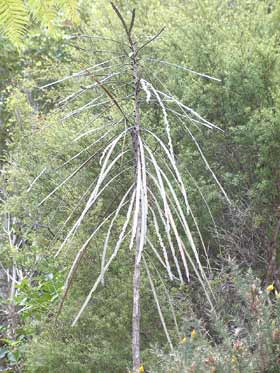
Small tree with distinctive draped thick long narrow toothed juvenile leaves
Distribution
Endemic. North, South and Stewart Islands. Widespread and common
Habitat
Lowland to montane forest. Sealevel to c. 750 m a.s.l.
Wetland plant indicator status rating
Information derived from the revised national wetland plant list prepared to assist councils in delineating and monitoring wetlands (Clarkson et al., 2021 Manaaki Whenua – Landcare Research Contract Report LC3975 for Hawke’s Bay Regional Council). The national plant list categorises plants by the extent to which they are found in wetlands and not ‘drylands’. The indicator status ratings are OBL (obligate wetland), FACW (facultative wetland), FAC (facultative), FACU (facultative upland), and UPL (obligate upland). If you have suggestions for the Wetland Indicator Status Rating, please contact: [Enable JavaScript to view protected content]
FACU: Facultative Upland
Occasionally is a hydrophyte but usually occurs in uplands (non-wetlands).
Detailed description
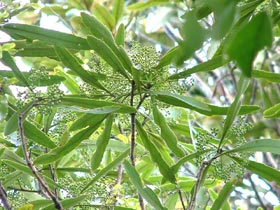
Bushy topped tree to 15 m tall, branchlets fleshy, trunk us. unbranched in lower part, to 50 cm diam., distinctly ridged when young, bark dark becoming paler with age, wood tough. Leaves alternate; leaflets 1-3 in seedling, palmate, sessile or subsessile on very short petiolule, submembranous coarsely toothed, absent from juvenile and adult. Juvenile leaves dark green, narrow-linear, deflexed, to 1 m long, coriaceous, midrib pale cream-yellow, raised, margins distantly sharply toothed, distal margin of tooth perpendicular to midvein, not swollen. Adult leaves shorter, 10-20 x 2-3 cm, dark green, very occ. trifoliate (probably due to hybridisation with oither species), narrow elliptic-cuneate to lanceolate or linear-obovate, acute or obtuse, margins entire to sunuate or coarsely serrate, subsessile or on petioles to 10 mm long, petiole base expanded around stem. Inflorescence a terminal umbel, irregularly compound; primary rays (branchlets) 5-10, c. 6 cm long; umbellules sometimes racemosely arranged. Ovary 5-loculed, each containing 1 ovule; style branches 5, connate, tips sometimes free. Fruit fleshy, subglobose, 4-5 mm diam., style branches retained on an apical disc, dark purple when ripe. Seeds 4-5 per fruit, easily separated, broadly ovate, grooved, 2.2-3.5(-5.5) mm long.
Similar taxa
Usually only confused with the rarer Pseudopanax ferox which has rounded discoloured teeth on the juvenile leaves, and darker brown adult leaves. Pseudopanax ferox also has a larger fruit.
Flowering
January-April
Flower colours
Green, Yellow
Fruiting
January-April
Etymology
pseudopanax: False cure
crassifolius: From the Latin crassus’ thick and folius ‘leaf’
Attribution
Description adapted from Allan (1961) and Webb and Simpson (2001).
References and further reading
Allan, H.H. 1961. Flora of NZ, Vol. I. Government Printer, Wellington
Webb, C.J. & Simpson, M.J.A. 2001. Seeds of NZ gymnosperms and dicotyledons. Manuka Press, Christchurch.