
Pseudopanax arboreus
Common names
fivefinger, five finger, whauwhaupaku
Biostatus
Native – Endemic taxon
Current conservation status
The conservation status of all known New Zealand vascular plant taxa at the rank of species and below were reassessed in 2022-2023 using the New Zealand Threat Classification System (NZTCS) – more information about this can be found on the NZTCS website. This report includes replaces all previous NZTCS lists for vascular plants. Previous assessments can be found here.
- Conservation status of vascular plants in Aotearoa New Zealand, 2023. 2024. Peter J. de Lange, Jane Gosden, Shannel P. Courtney, Alexander J. Fergus, John W. Barkla, Sarah M. Beadel, Paul D. Champion, Rowan Hindmarsh-Walls, Troy Makan and Pascale Michel Department of Conservation. Source: NZTCS and licensed by DOC for reuse under the Creative Commons Attribution 4.0 International licence.
2023 | Not Threatened
Category
Vascular
Structural class
Trees & Shrubs - Dicotyledons
Simplified description
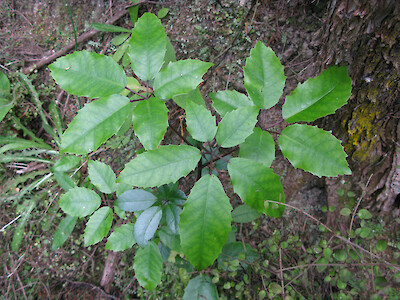
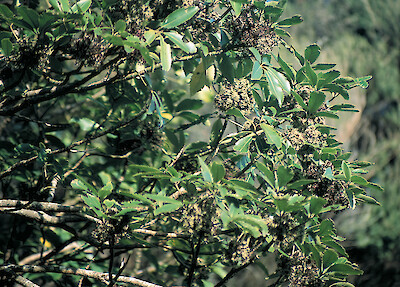
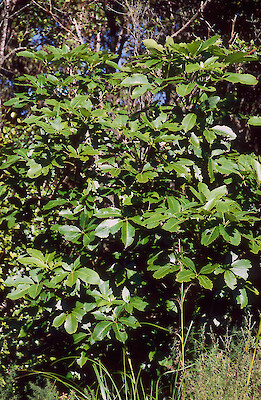
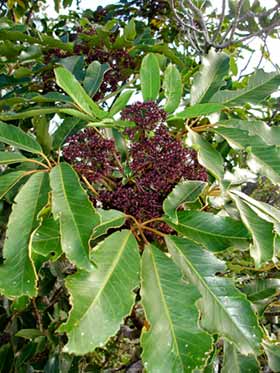
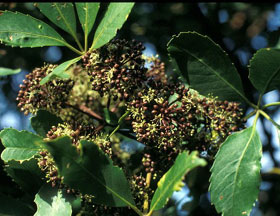
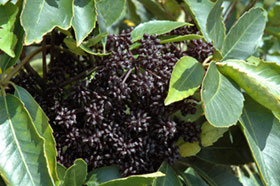
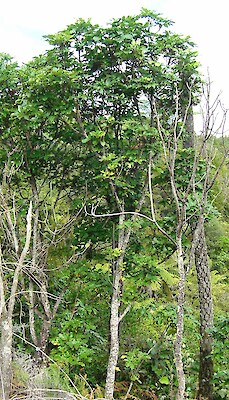
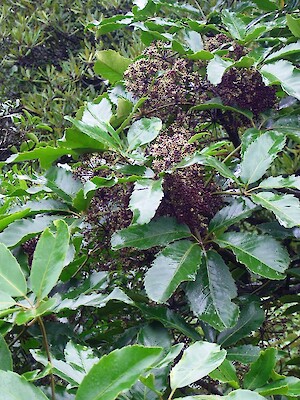
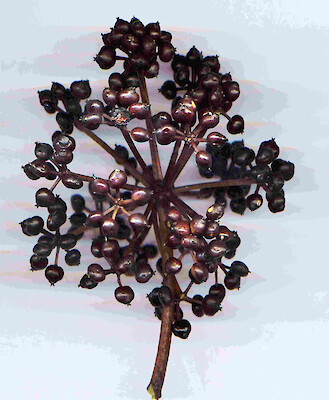
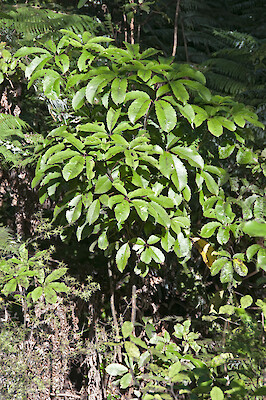
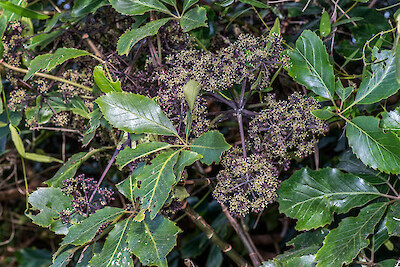
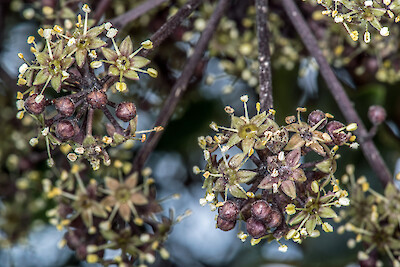
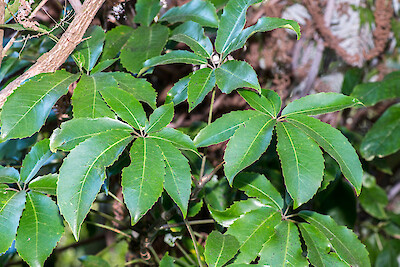
Small bushy tree with glossy green fleshy toothed margined leaves. Leaves are arranged in fans of 5 (occ. up to 7) leaflets, with a stem up to 20cm long, the attachment has an obvious sheathing. Fruit purple-black when ripe, in obvious clusters of star-like orbs.
Flower colours
Red/Pink, White
Detailed description
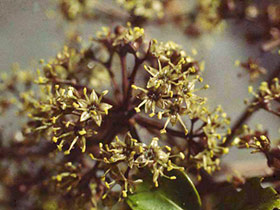
Usually dioecious. Small multi-branched tree to 8 m tall, branches and branchlets brittle. Leaves alternate, leaflets 5-7 (usually 5), palmate. Petioles approximately 15-20 cm long, sheathing branchlet at base. Petiolules approximately 3-5 cm long, pale green. Leaflets obovate-oblong to oblong-cuneate, thinly coriaceous, coarsely serrate-dentate, acute or acuminate to obtuse; midveins and main lateral veins obvious above and below; teminal lamina 10-20 × 4-7 cm. Inflorescence and panicle, terminal, compound; flowers usually unisexual; 8-20 primary rays (branchlets), up to 10 cm long; 15-20 secondary rays; umbellules with 10-15 flowers in each. Calyx truncate or obscurely 5-toothed; flowers about 5 mm diameter, sweet-scented; petals 5, white to pink flushed, ovate to triangular, acute; stamens 5, obvious, filaments usually equal length to petals; ovary 2-loculed, each containing 1(-2) ovules; style branches 2, spreading. Fruit fleshy, 5-8 mm diameter, style branches retained on an apical disc, very dark purple, laterally compressed. Seeds 2(-3) per fruit, wrinkled, 3-6 mm long.
Similar taxa
Similar to other Pseudopanax species, but has a greater number of leaflets borne on distinct petiolules. Vegetatively similar to Schefflera digitata (pate) which has thinner, finely serrate and larger leaflets with usually 7 leaflets per leaf.
Distribution
Endemic. Widespread (though rare in Central Otago). Te Ika-a-Māui | North Island and Te Waipounamu | South Island.
Habitat
Coastal to montane (10-750 m a.s.l.). Moist broadleaf forest. Frequently epiphytic. A frequent component of secondary forest. Streamsides and forest margins.
Threats
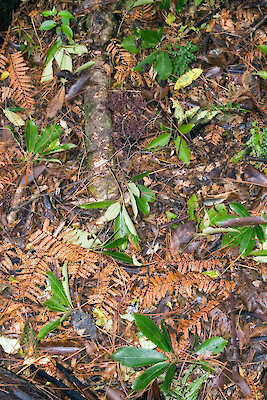
Not Threatened. In places the petiolules of Pseudopanax arboreus (and other fleshy-leaved Pseudopanax species) are a conspicuous element of possum (Trichosurus vulpecula) diet and the forest floor can become littered with discarded leaflets.
Detailed taxonomy
Genus
Family
Synonyms
Panax arboreus Murray, Panax arboreus Murray var. arboreus, Neopanax arboreus (Murray) Philipson var. arboreus, Pseudopanax arboreus (Murray) Philipson
Taxonomic notes
This species was transferred back to Neopanax Allan by: Frodin, D.G.; Govaerts, R. 2003: World Checklist and Bibliography of Araliaceae, The Cromwell Press, European Union.
Endemic taxon
Yes
Endemic genus
Yes
Endemic family
No
Ecology
Flowering
June to August
Fruiting
August to February
Propagation technique
Easy from fresh, cleaned, seed
Wetland plant indicator status rating
Information derived from the revised national wetland plant list prepared to assist councils in delineating and monitoring wetlands (Clarkson et al., 2021 Manaaki Whenua – Landcare Research Contract Report LC3975 for Hawke’s Bay Regional Council). The national plant list categorises plants by the extent to which they are found in wetlands and not ‘drylands’. The indicator status ratings are OBL (obligate wetland), FACW (facultative wetland), FAC (facultative), FACU (facultative upland), and UPL (obligate upland). If you have suggestions for the Wetland Indicator Status Rating, please contact: [Enable JavaScript to view protected content]
UPL: Obligate Upland
Rarely is a hydrophyte, almost always in uplands (non-wetlands).
Other information
Etymology
pseudopanax: False cure
arboreus: From the Latin arbor ‘tree’, meaning tree-like
NVS code
The National Vegetation Survey (NVS) Databank is a physical archive and electronic databank containing records of over 94,000 vegetation survey plots - including data from over 19,000 permanent plots. NVS maintains a standard set of species code abbreviations that correspond to standard scientific plant names from the Ngä Tipu o Aotearoa - New Zealand Plants database.
PSEARB
Chromosome number
2n = 48
Previous conservation statuses
The conservation status of all known New Zealand vascular plant taxa at the rank of species and below were reassessed in 2022-2023 using the New Zealand Threat Classification System (NZTCS) – more information about this can be found on the NZTCS website. This report includes replaces all previous NZTCS lists for vascular plants. Previous assessments can be found here.
- Conservation status of vascular plants in Aotearoa New Zealand, 2023. 2024. Peter J. de Lange, Jane Gosden, Shannel P. Courtney, Alexander J. Fergus, John W. Barkla, Sarah M. Beadel, Paul D. Champion, Rowan Hindmarsh-Walls, Troy Makan and Pascale Michel Department of Conservation. Source: NZTCS and licensed by DOC for reuse under the Creative Commons Attribution 4.0 International licence.
2017 | Not Threatened
2012 | Not Threatened
2009 | Not Threatened
2004 | Not Threatened
Regional conservation statuses
Auckland: 2025 | Regionally Not Threatened | Qualifiers: DPS, DPT
Current regional threat status assessments prepared according to Crisp et al. (2025) are displayed when available. The Auckland conservation status information is sourced from the “Conservation status of vascular plant species in Tāmaki Makaurau / Auckland” Simpkins E et al. (2025) report.
Otago: 2025 | Regionally Not Threatened
Current regional threat status assessments prepared according to Crisp et al. (2025) are displayed when available. The Otago conservation status information is sourced from the “Conservation Status of Indigenous Vascular Plants in Otago, 2025” Jarvie S et al. (2025) report.
Northland: 2026 | Regionally Not Threatened
Current regional threat status assessments prepared according to Crisp et al. (2025) are displayed when available. The Northland conservation status information is sourced from the “Conservation status of indigenous vascular plants in Northland | Taitokerau” Ford et al. 2026 report.
Referencing and citations
References and further reading
Allan HH. 1961. Flora of New Zealand, Volume I. Indigenous Tracheophyta: Psilopsida, Lycopsida, Filicopsida, Gymnospermae, Dicotyledones. Government Printer, Wellington, NZ. 1085 p.
Webb CJ & Simpson MJA. 2001. Seeds of NZ gymnosperms and dicotyledons. Manuka Press, Christchurch. 428 p.
Attribution
Description adapted from Allan (1961) and Webb and Simpson (2001).
Some of this factsheet information is derived from Flora of New Zealand Online and is used under a Creative Commons Attribution 3.0 New Zealand licence.