
Podocarpus totara var. waihoensis



Common names
tōtara, Westland tōtara
Biostatus
Native – Endemic taxon
Current conservation status
The conservation status of all known New Zealand vascular plant taxa at the rank of species and below were reassessed in 2022-2023 using the New Zealand Threat Classification System (NZTCS) – more information about this can be found on the NZTCS website. This report includes replaces all previous NZTCS lists for vascular plants. Previous assessments can be found here.
- Conservation status of vascular plants in Aotearoa New Zealand, 2023. 2024. Peter J. de Lange, Jane Gosden, Shannel P. Courtney, Alexander J. Fergus, John W. Barkla, Sarah M. Beadel, Paul D. Champion, Rowan Hindmarsh-Walls, Troy Makan and Pascale Michel Department of Conservation. Source: NZTCS and licensed by DOC for reuse under the Creative Commons Attribution 4.0 International licence.
2023 | Not Threatened
Category
Vascular
Structural class
Trees & Shrubs - Gymnosperms
Flower colours
No flowers
Detailed description
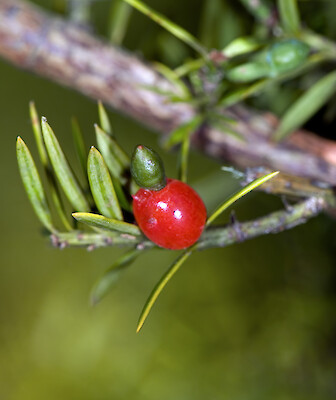
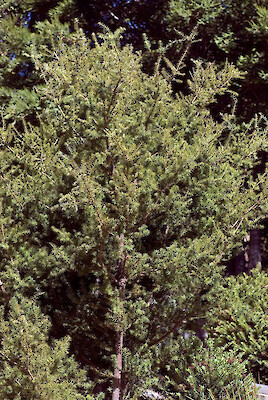
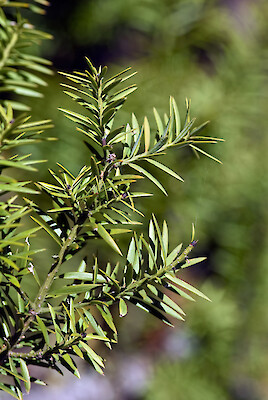
Dioecious, suckering conifer up to 10–15 m tall. Usually multi-trunked from base with 2–3–(numerous) erect, stilt-like trunks. These stout, (0.2)–1–1.5 m diameter, clad in firm, furrowed and somewhat stringy reddish-grey bark, branches stout, erect to somewhat spreading. Leaf bud narrower than or the same diameter as branchlet, surrounded by caducous, papery, narrowly lanceolate bracts. Leaves dark brownish-green to almost purple-brown, erect, leathery; 15–25 × 7–0.75-40 mm., linear, linear-lanceolate, acute to acuminate, apex pungent, mid-vein indistinct, stomatal lines obvious. Male cones (strobili) axillary 10–20 mm, solitary or in 4s. Female branchlets axillary, ovules solitary or paired, receptacle of 2–4 obtuse scales, somewhat subacute and free at tips, these maturing as a red, swollen, succulent, sweet tasting “fruit” surmounted by a 1–(2) broadly elliptic, ovoid-oblong 3–6 mm, semi-glossy, buff, grey nut brown, henna or dark brown (green to glaucous-green) when fresh, seed.
Similar taxa
Believed to have arisen through introgressive hybridism (see Wardle 1972). Very close to Podocarpus acutifolius—one of its postulated parents, and deriving from that species the suckering root stock, multi-trunked (from base) growth-form, and narrower needle-like leaves. However, it differs from that species by its distinctive tree habit. From tōtara it differs by the suckering and multi-trunked habit, narrow-linear leaves, much slender branches.
Distribution
Endemic. Confined to the West Coast of the South Island, from about the Waiho River south to the Cascades.
Habitat
Common in riparian and alluvial forest on poorly drained, flood-prone river terraces. Seemingly preferring recent soils overlying gravels.
Threats
Not Threatened. However this variety is only known from the southern half of the West Coast.
Detailed taxonomy
Genus
Family
Synonyms
Podocarpus totara subsp. waihoensis (Wardle) Silba
Taxonomic notes
Podocarpus totara var. waihoensis rarely (if ever) makes a large forest tree. Some botanists consider that var. waihoensis should be elevated to species rank. However, hybrid swarms between P. acutifolius and P. totara in northern Westland are rather hard to distinguish from var. waihoensis. There is a need to find further critical defining characters before such a step could be seriously contemplated.
Endemic taxon
Yes
Endemic genus
No
Endemic family
No
Ecology
Flowering
(August)–October–(December)
Fruiting
Fruits take a year or so to ripen, and may be found throughout the year, usually peaking at about the same time that cones are produced. They are most frequently seen between April and May.
Propagation technique
Easily grown from fresh seed and hard-wood cuttings.
Other information
Cultivation
Uncommon in cultivation. Not often seen in gardens and probably not commercially available.
Etymology
podocarpus: Foot or stalk fruit
totara: After the Maori name, totara
NVS code
The National Vegetation Survey (NVS) Databank is a physical archive and electronic databank containing records of over 94,000 vegetation survey plots - including data from over 19,000 permanent plots. NVS maintains a standard set of species code abbreviations that correspond to standard scientific plant names from the Ngä Tipu o Aotearoa - New Zealand Plants database.
PODTVW
Chromosome number
2n = 34
Previous conservation statuses
The conservation status of all known New Zealand vascular plant taxa at the rank of species and below were reassessed in 2022-2023 using the New Zealand Threat Classification System (NZTCS) – more information about this can be found on the NZTCS website. This report includes replaces all previous NZTCS lists for vascular plants. Previous assessments can be found here.
- Conservation status of vascular plants in Aotearoa New Zealand, 2023. 2024. Peter J. de Lange, Jane Gosden, Shannel P. Courtney, Alexander J. Fergus, John W. Barkla, Sarah M. Beadel, Paul D. Champion, Rowan Hindmarsh-Walls, Troy Makan and Pascale Michel Department of Conservation. Source: NZTCS and licensed by DOC for reuse under the Creative Commons Attribution 4.0 International licence.
2017 | Not Threatened
2012 | Not Threatened
2009 | Not Threatened
2004 | Not Threatened
Referencing and citations
References and further reading
Wardle P. 1972. Podocarpus totara var. waihoensis var. nov.: the result of introgressive hybridisation between P. totara and P. acutifolius. New Zealand Journal of Botany 10(1): 195–201. https://doi.org/10.1080/0028825X.1972.10430218.
Webb CJ, Simpson MJA. 2001. Seeds of New Zealand Gymnosperms and Dicotyledons. Manuka Press, Christchurch. 428 p.
Moorfield JC. 2005. Te aka : Māori-English, English-Māori dictionary and index. Pearson Longman, Auckland, N.Z. 357 p.
Attribution
Fact sheet prepared for NZPCN by P.J. de Lange 1 January 2007. Description adapted from Wardle (1972) and Webb & Simpson (2001).