
Ptisana salicina
Common names
king fern, para, tawhiti para, horseshoe fern
Biostatus
Native
Current conservation status
The conservation status of all known New Zealand vascular plant taxa at the rank of species and below were reassessed in 2022-2023 using the New Zealand Threat Classification System (NZTCS) – more information about this can be found on the NZTCS website. This report includes replaces all previous NZTCS lists for vascular plants. Previous assessments can be found here.
- Conservation status of vascular plants in Aotearoa New Zealand, 2023. 2024. Peter J. de Lange, Jane Gosden, Shannel P. Courtney, Alexander J. Fergus, John W. Barkla, Sarah M. Beadel, Paul D. Champion, Rowan Hindmarsh-Walls, Troy Makan and Pascale Michel Department of Conservation. Source: NZTCS and licensed by DOC for reuse under the Creative Commons Attribution 4.0 International licence.
2023 | At Risk – Declining | Qualifiers: SO
Category
Vascular
Structural class
Ferns
Flower colours
No flowers
Detailed description
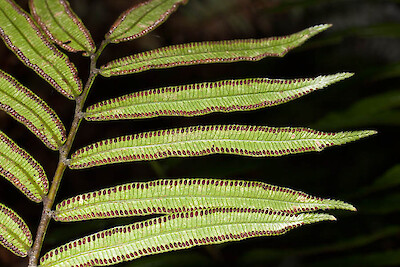
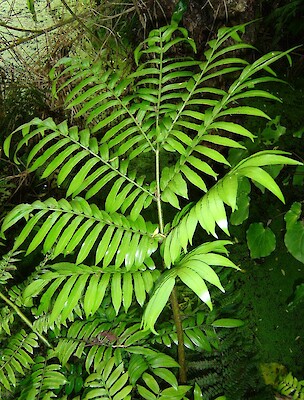
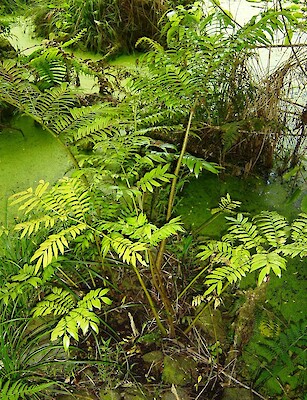
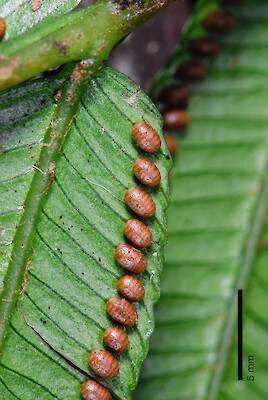
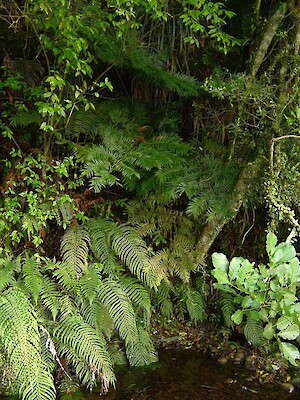
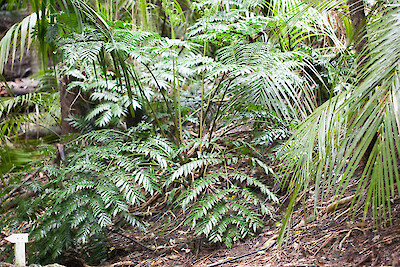
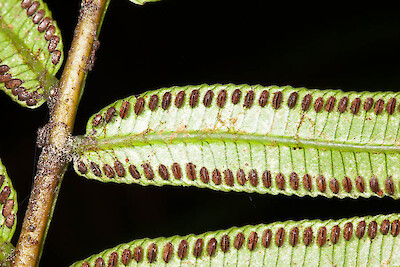
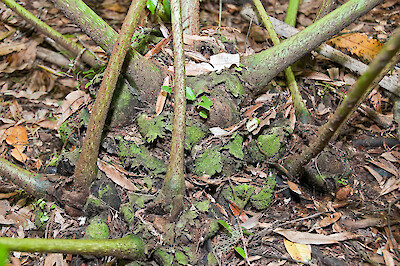
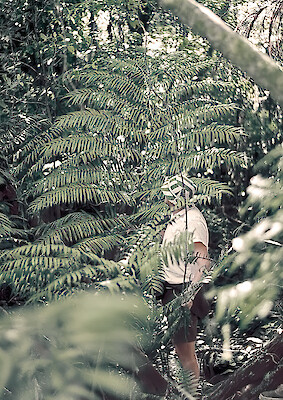
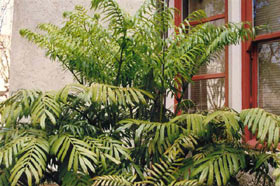
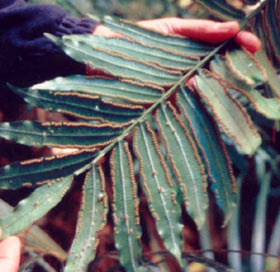
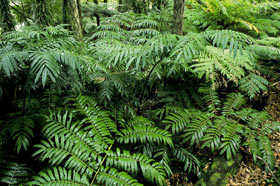
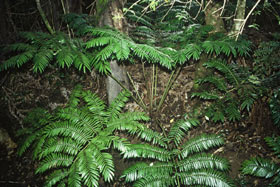
A large, robust fern with fronds to 5 m tall arising from a stout, starchy base that was a traditional food for the Māori. Leaf stalks cane-like, green, 1–3 m long, and have a large basal, ear-like lobe that protects the uncoiling frond. Fronds dark glossy green (or yellow-green in stressed sites), 2-pinnate, up to 4 m × 2 m. Juvenile fronds less robust, wilting easily on exposure to sunlight, with the strap-like secondary pinnae often lobed or serrated. Midribs of the primary pinnae swollen at the junction with the main stem. Secondary pinnae entire, oblong, strap-like, and taper towards the tip. Sori distinctively boat-shaped. An unusual form with crested tips to the adult pinnules is sometimes found in the wild around the Kawhia area.
Similar taxa
None
Distribution
Indigenous. New Zealand throughout the north-western half of the North Island from inland Wanganui northwards. Waikato is probably its stronghold where it is known from many remnants and forested areas in the west. Also South Pacific (possibly elsewhere).
Habitat
Favouring lowland, karst habitats (cave entrances and tomo shafts) and dark stream sides, often amongst supplejack (Ripogonum scandens) and parataniwha (Elatostema rugosum).
Threats
Feral and domestic stock, wild pig and goat browse are serious threats throughout its range. Indeed large specimens are only found where there has been intensive animal control, in inaccessible cave and tomo entrances or in steep-walled limestone gorges. Aside from animals the most serious threat to this species comes from plant collectors who have been responsible for the recent loss of several large, reasonably accessible populations near Kawhia.
Detailed taxonomy
Genus
Family
Synonyms
Marattia salicina J.E. Sm.; Marattia fraxinea Smith, Marattia fraxinea sensu J.B.Armstr.
Endemic taxon
No
Endemic genus
No
Endemic family
No
Ecology
Flowering
Specimens of suitable age may produce sporangia at any time.
Propagation technique
Difficult. Can be grown from spores but very slow.
Other information
Cultivation
Periodically offered by most commercial garden centres. Plants are held by several specialist native plant nurseries.
Etymology
ptisana: From the Latin ptisana ‘barley grains’, in reference to the fused sporangia of the fern have the appearance of pearl barley
salicina: Willow-like
NVS code
The National Vegetation Survey (NVS) Databank is a physical archive and electronic databank containing records of over 94,000 vegetation survey plots - including data from over 19,000 permanent plots. NVS maintains a standard set of species code abbreviations that correspond to standard scientific plant names from the Ngä Tipu o Aotearoa - New Zealand Plants database.
PTISAL
Chromosome number
2n = 78
Previous conservation statuses
The conservation status of all known New Zealand vascular plant taxa at the rank of species and below were reassessed in 2022-2023 using the New Zealand Threat Classification System (NZTCS) – more information about this can be found on the NZTCS website. This report includes replaces all previous NZTCS lists for vascular plants. Previous assessments can be found here.
- Conservation status of vascular plants in Aotearoa New Zealand, 2023. 2024. Peter J. de Lange, Jane Gosden, Shannel P. Courtney, Alexander J. Fergus, John W. Barkla, Sarah M. Beadel, Paul D. Champion, Rowan Hindmarsh-Walls, Troy Makan and Pascale Michel Department of Conservation. Source: NZTCS and licensed by DOC for reuse under the Creative Commons Attribution 4.0 International licence.
2017 | At Risk – Declining | Qualifiers: SO
2012 | At Risk – Declining | Qualifiers: SO
2009 | At Risk – Declining | Qualifiers: SO
2004 | Serious Decline
Regional conservation statuses
Northland: 2026 | Regionally Threatened – Regionally Vulnerable
Current regional threat status assessments prepared according to Crisp et al. (2025) are displayed when available. The Northland conservation status information is sourced from the “Conservation status of indigenous vascular plants in Northland | Taitokerau” Ford et al. 2026 report.
Auckland: 2025 | Regionally At Risk – Regionally Declining | Qualifiers: DPS, DPT, PF, TO
Current regional threat status assessments prepared according to Crisp et al. (2025) are displayed when available. The Auckland conservation status information is sourced from the “Conservation status of vascular plant species in Tāmaki Makaurau / Auckland” Simpkins E et al. 2025 report.
Referencing and citations
References and further reading
Murdock AG. 2008. A taxonomic revision of the eusporangiate fern family Marattiaceae, with description of the new genus Ptisana. Taxon 57(3): 737–755. https://doi.org/10.1002/tax.573007.
Attribution
Fact Sheet prepared for NZPCN by P.J. de Lange 1 August 2003.
NZPCN Fact Sheet citation
Please cite as: de Lange, P.J. (Year at time of access): Ptisana salicina Fact Sheet (content continuously updated). New Zealand Plant Conservation Network. https://www.nzpcn.org.nz/flora/species/ptisana-salicina/ (Date website was queried)